
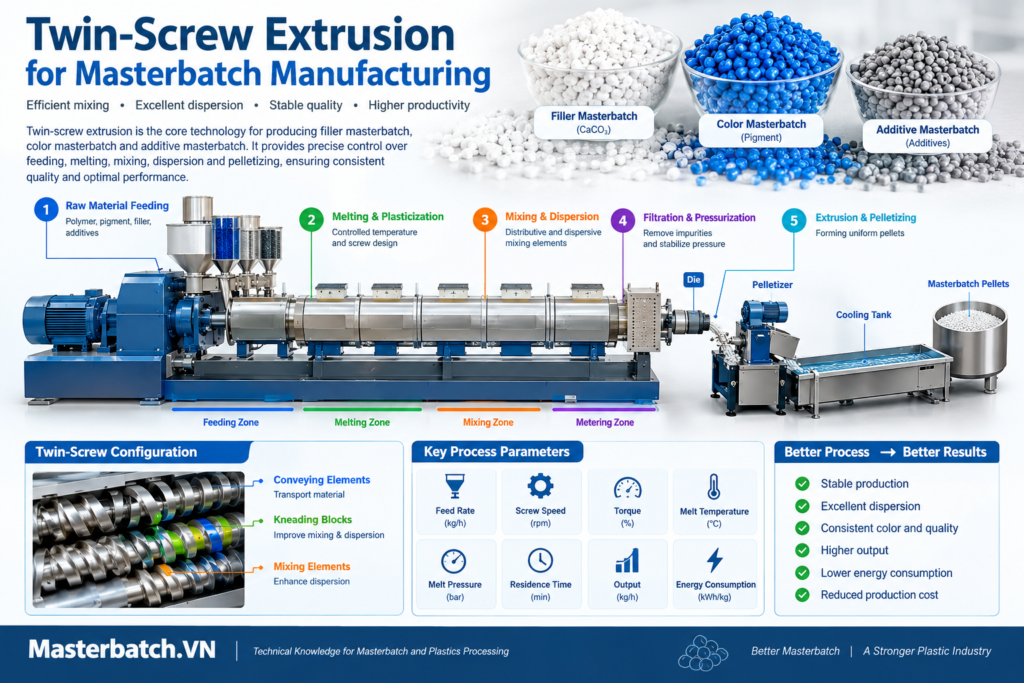
For masterbatch manufacturers, the main objective is not simply to increase extruder speed. A stable production process must balance formulation, screw configuration, feed rate, screw speed, melt temperature, torque, pressure, residence time and dispersion quality.
1. What Is Twin-Screw Extrusion?
A twin-screw extruder uses two rotating screws inside a heated barrel to transport, melt, mix and compound polymer materials. Depending on the machine design, the screws can be configured with conveying elements, kneading blocks and other mixing elements to control melting and dispersion.
For masterbatch production, twin-screw extrusion is particularly useful because it can process concentrated pigments, calcium carbonate, additives and polymer carriers while providing a relatively high level of mixing and process control.
2. Typical Masterbatch Extrusion Process
A typical manufacturing process can be summarized as:
- Raw material preparation
- Premixing or separate feeding
- Polymer and additive feeding
- Melting and plasticization
- Distributive mixing
- Dispersive mixing
- Pressure development
- Melt filtration
- Die extrusion
- Pelletizing
- Cooling and packaging
The actual process sequence depends on the formulation, polymer carrier, filler or pigment concentration, extruder design and final application.
3. Feeding System and Feed Rate
Stable feeding is fundamental to stable masterbatch production. The gravimetric or volumetric feeding system must provide a consistent material flow into the extruder.
Feed rate directly affects production output, motor torque, melt pressure and residence time. Excessive feeding can overload the extruder, while insufficient feeding can reduce output and create unstable processing conditions.
For high-loading filler masterbatch, special attention should be given to powder flowability, bridging, bulk density variation and feeder calibration.
4. Screw Speed and Extruder Output
Screw speed is one of the major operating parameters in twin-screw extrusion. Increasing screw speed can increase conveying capacity and production output, but it can also increase shear, melt temperature, energy consumption and mechanical load depending on the screw configuration and formulation.
Therefore, increasing RPM alone is not a reliable strategy for maximizing masterbatch production. A better approach is to optimize the relationship between feed rate, screw speed, torque, melt temperature, pressure and product dispersion.
5. Screw Configuration for Masterbatch
Screw configuration determines how materials are transported, melted and mixed. A typical masterbatch screw may contain different zones for conveying, plasticization and mixing.
Conveying elements primarily transport material through the barrel, while kneading and mixing elements increase the interaction between polymer, pigments, fillers and additives.
The correct configuration depends on the formulation. A screw design suitable for a high-loading CaCO3 filler masterbatch may not be optimal for a high-pigment color masterbatch or a heat-sensitive additive masterbatch.
6. Distributive and Dispersive Mixing
Masterbatch quality depends strongly on mixing performance.
Distributive Mixing
Distributive mixing aims to distribute the different components uniformly throughout the polymer melt without necessarily breaking individual agglomerates.
Dispersive Mixing
Dispersive mixing applies sufficient stress to reduce agglomerates and improve the dispersion of pigments, fillers or additives within the polymer matrix.
An appropriate balance between distributive and dispersive mixing is required. Excessive shear may increase melt temperature or polymer degradation, while insufficient mixing may result in poor dispersion, color variation, specks or unstable downstream processing.
7. Temperature Control
Temperature control is critical in masterbatch extrusion. Barrel temperature, feed conditions, screw speed and mechanical shear all contribute to the actual melt temperature.
The displayed barrel temperature should therefore not be considered identical to the actual polymer melt temperature.
An excessively high melt temperature may cause polymer degradation, additive degradation, discoloration or excessive energy consumption. Conversely, an insufficient temperature profile may result in incomplete melting, poor mixing or excessive torque.
8. Extruder Torque and Motor Load
Torque and motor current provide useful information about the mechanical load on the extrusion system.
High torque may be associated with factors such as:
- Excessive feed rate
- High filler or pigment loading
- Insufficient melt temperature
- High-viscosity polymer
- Excessive screw shear
- Restricted screen pack or die
- Unsuitable screw configuration
- Material agglomeration or contamination
When torque increases unexpectedly, engineers should investigate the complete process rather than simply increasing barrel temperature.
9. Melt Pressure and Filtration
Melt pressure provides another important indication of extrusion stability. Increasing pressure may be caused by excessive output, high melt viscosity, restricted filtration, die restriction or contamination.
For color and filler masterbatch, melt filtration can also help remove contaminants and large unmelted particles. However, an excessively restrictive filter can increase pressure and reduce production efficiency.
10. Residence Time and Dispersion
Residence time describes how long material remains inside the extrusion system. It influences melting, mixing and thermal exposure.
Too little residence time may result in incomplete melting or insufficient dispersion. Excessive residence time may increase thermal history and the risk of polymer or additive degradation.
The optimum residence time depends on the formulation, screw design, feed rate, screw speed and processing temperature.
11. How to Increase Masterbatch Production Output
Increasing production output should be approached as a process optimization problem rather than simply increasing screw RPM.
Engineers should evaluate:
- Maximum stable feed rate
- Screw speed
- Motor torque
- Melt pressure
- Melt temperature
- Screen-pack restriction
- Screw configuration
- Pelletizer capacity
- Cooling capacity
- Product dispersion
The target should be the highest stable throughput that maintains the required quality specification.
12. Common Twin-Screw Extrusion Problems
| Problem | Possible Causes |
|---|---|
| High torque | High feed rate, high viscosity, excessive shear, low melt temperature |
| High melt pressure | Restricted screen, die restriction, contamination, excessive output |
| Poor dispersion | Insufficient mixing, unsuitable screw configuration, poor formulation |
| Color variation | Poor pigment dispersion, feeding variation, formulation variation |
| Black or white specks | Contamination, agglomeration, degradation or poor dispersion |
| Low production output | Low feed rate, restricted filtration, unstable feeding or downstream limitation |
| High melt temperature | Excessive shear, high screw speed or excessive mechanical energy |
13. Parameters That Should Be Monitored
A masterbatch extrusion line should be monitored using a combination of machine, material and laboratory parameters.
- Feed rate (kg/h)
- Screw speed (rpm)
- Motor current (A)
- Torque (%)
- Barrel temperature (°C)
- Melt temperature (°C)
- Melt pressure (bar)
- Production output (kg/h)
- Specific energy consumption (kWh/kg or kWh/ton)
- MFI/MFR
- Moisture
- Dispersion
- Color difference (ΔE)
- Pellet quality
14. How Engineers Can Optimize Masterbatch Production
A practical optimization program should establish a baseline production condition and then change one major variable at a time where possible.
For example, engineers can record output, torque, pressure, melt temperature, energy consumption and product quality at different combinations of feed rate and screw speed.
The objective is to identify a stable operating window rather than a single machine setting. This approach is particularly important when different formulations, raw material lots or recycled polymers are introduced into production.
15. Conclusion
Twin-screw extrusion is a core technology for modern masterbatch manufacturing. High-quality production requires coordination between formulation design, feeding, screw configuration, mixing, temperature control, filtration, pelletizing and quality control.
For filler, color and additive masterbatch, the most important engineering principle is to optimize the complete process rather than maximizing a single parameter such as screw speed or production rate.
Masterbatch.VN provides technical information covering masterbatch formulation, twin-screw extrusion, dispersion, testing, troubleshooting, production optimization and plastic processing applications.
twin screw extruder for masterbatch masterbatch extrusion process masterbatch compounding masterbatch screw configuration masterbatch dispersion masterbatch production process twin screw extrusion parameters filler masterbatch extrusion color masterbatch extrusion masterbatch production optimization