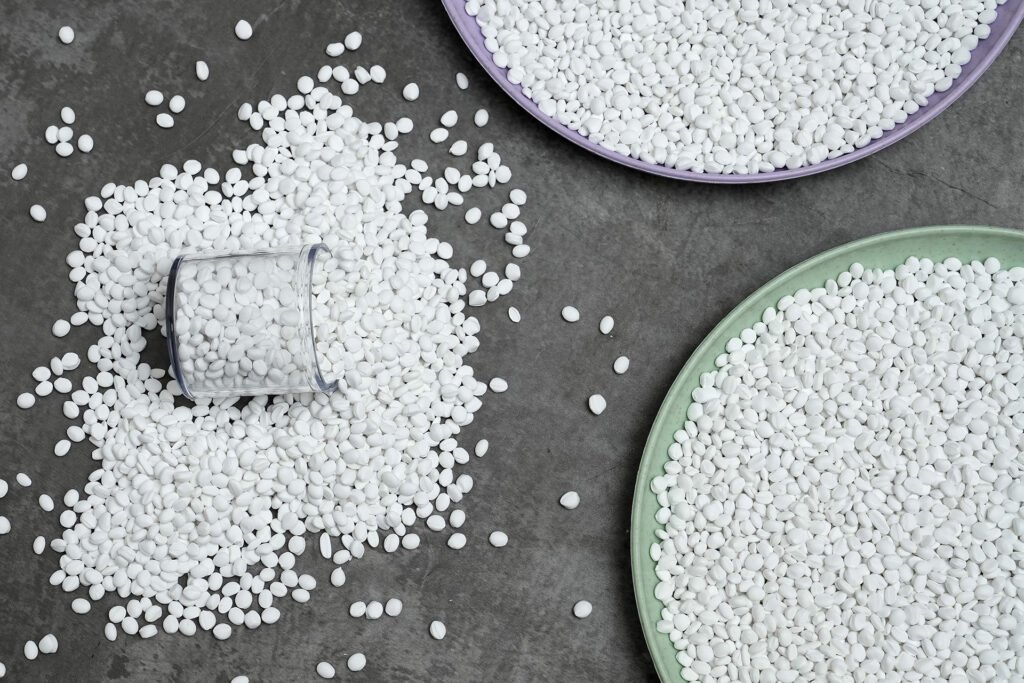
Understanding different types of plastic raw materials is essential for manufacturers looking to improve production efficiency, control material costs and maintain consistent product quality.
Depending on the application, plastic manufacturers may use virgin resin, recycled resin, filler masterbatch, color masterbatch, plastic compounds and functional additives. Selecting the right combination can have a significant impact on processing performance, mechanical properties, appearance and overall production costs.
Masterbatch.vn provides technical information and solutions for plastic raw materials, helping manufacturers evaluate suitable materials for film blowing, injection molding, extrusion, woven bags and other plastic-processing applications.
1. What Are Plastic Raw Materials?
Plastic raw materials are polymers, compounds, masterbatches, fillers and additives used to manufacture plastic products.
They can generally be divided into several major categories:
- Virgin plastic resin
- Recycled plastic resin
- Filler masterbatch
- Color masterbatch
- Functional masterbatch
- Plastic compounds
- Performance additives
Each material has a different role in the production process.
For example, virgin PP or PE provides the primary polymer structure, while filler masterbatch can help optimize material costs and stiffness. Color masterbatch provides consistent color, while functional additives can improve UV resistance, processing stability, flame resistance or other specific properties.
The correct material selection should always consider the final product requirements, processing technology and target cost.
2. Main Types of Plastic Raw Materials
2.1. Filler Masterbatch for Cost Optimization
Filler Masterbatch is a concentrated plastic additive containing mineral filler, commonly calcium carbonate (CaCO₃), dispersed in a polymer carrier such as PE or PP.
It is widely used by plastic manufacturers to optimize polymer consumption and production costs while modifying selected physical properties.
Typical benefits may include:
- Reduced virgin polymer consumption
- Material cost optimization
- Increased stiffness in suitable formulations
- Improved dimensional stability
- Good processing performance
- Consistent filler dispersion
Common applications include:
- Plastic bags
- PE films
- PP woven bags
- Jumbo bags
- Injection-molded products
- Extruded sheets
- Plastic profiles
- Selected pipes and industrial products
The performance of filler masterbatch depends on factors such as CaCO₃ content, particle size, carrier resin, dispersion quality and dosage.
Therefore, the cheapest masterbatch is not necessarily the most economical choice. A better approach is to evaluate the cost-performance ratio based on the finished product.
2.2. High-Quality Color Masterbatch
Color Masterbatch is a concentrated mixture of pigments or dyes dispersed in a compatible polymer carrier.
It is used to produce consistent and attractive colors in plastic products.
Color masterbatch can provide:
- Excellent color consistency
- Good pigment dispersion
- Heat stability
- UV resistance for selected grades
- Easy dosing and mixing
- Consistent appearance between production batches
Common colors include:
- White
- Black
- Red
- Blue
- Yellow
- Green
- Orange
- Custom colors
Color masterbatch is widely used in:
- Plastic packaging
- Household products
- Automotive components
- Electrical and electronic products
- Construction plastics
- Agricultural films
- Consumer goods
For demanding applications, manufacturers may require customized color matching and laboratory testing to achieve the required ΔE color tolerance, opacity, gloss and heat resistance.
3. Plastic Compound
Plastic Compound is a pre-formulated polymer material containing a base resin combined with additives, fillers, reinforcements, pigments or other functional components.
Unlike conventional masterbatch, which is normally used at a relatively low dosage, a compound is typically designed to be used as the primary material for manufacturing a finished plastic product.
Depending on the formulation, plastic compounds can be engineered to improve:
- Tensile strength
- Impact resistance
- Stiffness
- Flexibility
- Heat resistance
- Flame resistance
- UV resistance
- Dimensional stability
- Surface appearance
Plastic compounds are commonly used in:
- Automotive components
- Electrical and electronic parts
- Industrial products
- Consumer appliances
- Engineering plastics
- Construction applications
Customized compounding allows manufacturers to achieve specific performance requirements that may not be possible with standard polymer grades alone.
4. Functional Plastic Additives
Plastic additives are specialized ingredients used in relatively small quantities to modify or improve specific properties of polymers.
Common additive categories include:
Antioxidants
Antioxidants help protect polymers from thermal and oxidative degradation during processing and long-term use.
UV Stabilizers
UV stabilizers can help reduce degradation caused by ultraviolet radiation, making them particularly useful for selected outdoor applications.
Impact Modifiers
Impact modifiers can improve toughness and impact resistance in suitable polymer systems.
Flame Retardants
Flame-retardant additives are used in applications where improved fire performance is required.
Processing Aids
Processing additives can help improve melt flow, surface quality, extrusion stability and production efficiency.
Slip and Antiblock Additives
These additives are commonly used in plastic films to modify surface friction and reduce unwanted film-to-film adhesion.
The correct additive must be selected according to the polymer type, processing temperature and final product requirements.
5. Virgin Plastic Resin
Virgin plastic resin is polymer material that has not previously been processed into a finished plastic product.
Common virgin resins include:
- PE – Polyethylene
- PP – Polypropylene
- HDPE – High-Density Polyethylene
- LDPE – Low-Density Polyethylene
- LLDPE – Linear Low-Density Polyethylene
- PET – Polyethylene Terephthalate
- PVC – Polyvinyl Chloride
- PS – Polystyrene
- ABS – Acrylonitrile Butadiene Styrene
- PC – Polycarbonate
Virgin resin is selected according to the required mechanical properties, processing technology and application.
For example:
PE is widely used for films, bags and packaging.
PP is commonly used for woven bags, injection molding, household products and automotive applications.
ABS is widely used for products requiring good impact resistance and surface appearance.
6. Recycled Plastic Raw Materials
Recycled plastic materials are produced by processing plastic waste or post-industrial materials into reusable polymer materials.
Depending on quality and processing technology, recycled materials can be used in:
- Packaging
- Industrial products
- Plastic bags
- Construction products
- Household goods
- Automotive components
- Injection-molded products
The main advantage is the potential to reduce the consumption of virgin polymer and support more efficient material utilization.
However, recycled resin quality can vary according to:
- Original polymer type
- Contamination
- Processing history
- Moisture
- Additive content
- MFI/MFR
- Color
- Thermal degradation
Therefore, manufacturers should evaluate recycled materials carefully before introducing them into a production formulation.
7. Benefits of Choosing the Right Plastic Raw Materials
Selecting the correct combination of plastic raw materials can provide significant technical and economic benefits.
7.1. Better Product Quality
Correct material selection helps manufacturers maintain consistent:
- Strength
- Stiffness
- Color
- Surface appearance
- Dimensional stability
- Processing performance
7.2. Production Cost Optimization
Using filler masterbatch, recycled materials or customized compounds appropriately can reduce material costs without unnecessarily compromising product performance.
7.3. Improved Processing Efficiency
Materials with suitable MFI/MFR, dispersion and thermal stability can improve production stability and reduce processing problems.
7.4. Consistent Production
Stable raw materials help manufacturers maintain consistent product quality from one production batch to another.
7.5. Application-Specific Performance
A customized material formulation can be developed for specific requirements such as:
- High stiffness
- High impact resistance
- Transparency
- UV resistance
- Flame resistance
- Heat resistance
- Surface gloss
- Low-cost production
8. How to Select Plastic Raw Materials for Manufacturing
Choosing plastic raw materials should not be based solely on purchase price.
Manufacturers should evaluate several technical parameters.
8.1. Polymer Type
First determine whether the product is manufactured from:
- PE
- PP
- PET
- PVC
- ABS
- PS
- PC
- Or another polymer
The masterbatch or additive must be compatible with the base resin.
8.2. Processing Technology
The correct material depends on the manufacturing process.
Film Blowing
Commonly uses PE-based materials and requires good melt stability, dispersion and film performance.
Injection Molding
Requires appropriate flow properties, dimensional stability and mechanical performance.
Extrusion
Requires stable melt processing and good dispersion.
PP Woven Bags
Typically require PP-compatible filler masterbatch, color masterbatch and other suitable additives.
8.3. Required Product Performance
Manufacturers should identify the most important product specifications before selecting materials.
These may include:
- Tensile strength
- Elongation
- Impact resistance
- Stiffness
- Transparency
- Gloss
- UV resistance
- Heat resistance
- Flame resistance
8.4. Target Production Cost
The objective should be to achieve the required product performance at the most efficient overall formulation cost.
A lower-cost raw material can sometimes increase production problems or reduce product quality, resulting in a higher total cost.
9. Filler Masterbatch vs. Virgin Plastic Resin
One common strategy in plastic manufacturing is to combine virgin polymer with filler masterbatch.
For example, a PE or PP formulation may contain:
Virgin Resin + Filler Masterbatch + Color Masterbatch + Functional Additives
The exact formulation depends on the product and processing technology.
The purpose is not simply to replace as much virgin resin as possible, but to achieve the best balance between:
Cost + Mechanical Performance + Processing + Appearance + Product Quality
This approach is especially relevant for high-volume plastic products where raw-material costs have a significant impact on total production costs.
10. Color Masterbatch and Filler Masterbatch Combination
In many plastic applications, manufacturers use both filler masterbatch and color masterbatch.
For example:
PP Resin + PP Filler Masterbatch + Color Masterbatch
or:
PE Resin + PE Filler Masterbatch + Color Masterbatch
The filler masterbatch can help optimize material cost and selected physical properties, while the color masterbatch provides the desired color.
The compatibility between the carrier resin of each masterbatch and the base polymer is important for achieving stable dispersion.
11. Quality Control of Plastic Raw Materials
Professional raw-material quality control should include both incoming-material inspection and production testing.
Important parameters may include:
- MFI / MFR
- Moisture content
- Density
- Filler concentration
- Pigment concentration
- Particle dispersion
- Color difference
- Thermal stability
- Ash content
- Mechanical properties
For color masterbatch, manufacturers may also evaluate color strength, ΔE, opacity, heat resistance and dispersion.
For filler masterbatch, testing may focus on filler loading, dispersion, density, MFI and final-product mechanical properties.
Consistent quality control is essential for manufacturers supplying products to demanding domestic and export markets.
12. How Masterbatch.vn Can Support Plastic Manufacturers
Masterbatch.vn focuses on information and solutions related to plastic raw materials, filler masterbatch, color masterbatch, plastic compounds and additives.
Our approach is based on helping manufacturers select materials according to actual production requirements rather than simply choosing the lowest purchase price.
Technical considerations may include:
- Polymer compatibility
- Processing technology
- Required dosage
- Product specifications
- Material cost
- Production stability
- Final application
For manufacturers looking to optimize their formulations, technical consultation and sample testing can be valuable before moving to large-scale production.
13. Plastic Raw Materials for Different Applications
Different industries require different material combinations.
Plastic Packaging
Common materials include:
- PE
- PP
- Filler masterbatch
- Color masterbatch
- Processing additives
PP Woven Bags
Typical materials include:
- PP resin
- PP filler masterbatch
- Color masterbatch
- Processing additives
Injection-Molded Products
Manufacturers may use:
- PP
- ABS
- PS
- PE
- Engineering compounds
- Color masterbatch
- Functional additives
Agricultural Films
Typical formulations may include:
- LDPE
- LLDPE
- Color masterbatch
- UV stabilizer
- Filler masterbatch where technically appropriate
The final formulation should always be validated through actual production testing.
14. Why Material Selection Is More Important Than Simply Buying Cheap Raw Materials
The lowest purchase price does not always produce the lowest manufacturing cost.
A material that appears inexpensive may cause:
- Higher reject rates
- Poor dispersion
- Color variation
- Processing instability
- Lower mechanical performance
- Increased maintenance
- Reduced production speed
Therefore, professional manufacturers should evaluate total production economics rather than material price alone.
A better strategy is to identify the optimum formulation cost per finished product, while maintaining the required technical specifications.
15. Frequently Asked Questions About Plastic Raw Materials
What are the main types of plastic raw materials?
The main categories include virgin resin, recycled resin, filler masterbatch, color masterbatch, plastic compounds and functional additives.
What is Filler Masterbatch?
Filler Masterbatch is a concentrated material containing mineral filler, commonly CaCO₃, dispersed in a compatible polymer carrier. It is used to optimize material cost and modify selected properties of plastic products.
What is Color Masterbatch?
Color Masterbatch is a concentrated pigment or dye system used to provide consistent color to plastic products.
What is Plastic Compound?
Plastic Compound is a pre-formulated polymer containing additives, fillers, pigments, reinforcements or other functional ingredients designed to provide specific performance characteristics.
How do I choose the right plastic raw material?
Consider the polymer type, processing technology, required product properties, masterbatch compatibility, dosage, quality requirements and target production cost.
Is the cheapest raw material always the best option?
No. The best material is the one that provides the required product performance at the lowest practical total production cost, not necessarily the lowest purchase price.
16. Conclusion
Plastic raw materials are the foundation of modern plastic manufacturing. Choosing the right combination of virgin resin, recycled resin, filler masterbatch, color masterbatch, plastic compounds and functional additives can significantly influence product quality, production efficiency and profitability.
For cost-sensitive applications, Filler Masterbatch can be an effective tool for optimizing polymer consumption when correctly formulated and dosed.
For appearance-sensitive products, Color Masterbatch provides controlled and consistent color.
For demanding technical applications, Plastic Compound can deliver customized mechanical, thermal and functional properties.
The most effective approach is therefore not simply to search for the cheapest raw material, but to develop a technically optimized formulation based on:
Material Quality + Compatibility + Processing + Performance + Cost Efficiency
About Masterbatch.vn
Masterbatch.vn is an information and solution platform focused on plastic raw materials, filler masterbatch, color masterbatch, plastic compounds and plastic additives.
We aim to support plastic manufacturers in understanding material technologies, comparing suitable options and developing more efficient production formulations.
For technical inquiries, material consultation or future product development:
Masterbatch.vn
Ho Chi Minh City, Vietnam
Email: info@masterbatch.vn
Website: masterbatch.vn