
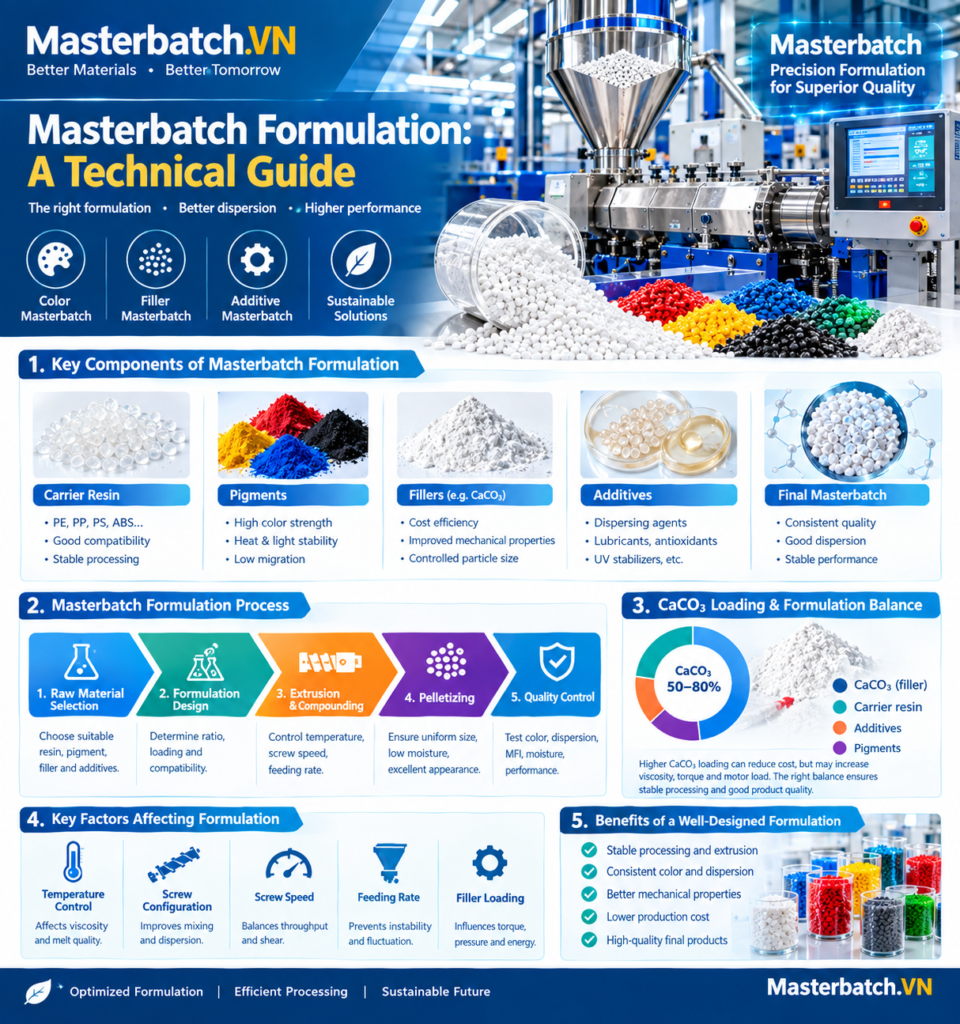
Masterbatch Formulation: A Technical Guide
Masterbatch formulation is the foundation of consistent color, filler performance, processing stability and final product quality. A well-designed formulation must balance raw materials, dispersion, polymer compatibility and extrusion conditions.
What Is Masterbatch Formulation?
Masterbatch formulation is the controlled combination of a carrier polymer, pigments, fillers and functional additives into a concentrated compound. The concentrate is later diluted into the base polymer during plastic processing.
The formulation depends on the application, polymer type, required concentration, processing temperature, mechanical requirements and target color or functionality.
Key Components of a Masterbatch Formulation
“`1. Carrier Resin
The carrier resin provides compatibility with the target polymer and helps transport pigments, fillers and additives through the extrusion process. Common carriers include PE, PP, PS, ABS and other compatible polymers.
2. Pigments
Color masterbatch formulations use organic or inorganic pigments selected for color strength, heat resistance, migration resistance, light fastness and chemical stability.
3. Fillers
Filler masterbatch commonly uses calcium carbonate (CaCO3), talc or other mineral fillers. Particle size, surface treatment, purity and loading level strongly influence dispersion and extrusion behavior.
4. Additives
Depending on the application, additives may include dispersing agents, lubricants, antioxidants, UV stabilizers, processing aids, antiblocking agents and other functional materials.
“`How to Design a Masterbatch Formulation
“`- Define the application: Identify the final plastic product and processing method.
- Select the carrier: Match the carrier resin with the base polymer.
- Determine concentration: Establish pigment, filler or additive loading.
- Optimize dispersion: Select suitable dispersing and processing additives.
- Balance rheology: Avoid excessive viscosity, torque or motor load.
- Optimize extrusion: Adjust screw configuration, temperature, feeding and screw speed.
- Validate quality: Test color, dispersion, moisture, MFI, mechanical properties and processing stability.
Filler Masterbatch Formulation and CaCO3 Loading
In calcium carbonate masterbatch production, increasing CaCO3 loading can reduce formulation cost and increase filler concentration, but excessive loading may create processing challenges.
“`High CaCO3 loading may increase melt viscosity, extrusion torque and motor amperage. Poor feeding, insufficient dispersion or unsuitable screw configuration can further increase mechanical load on a twin-screw extruder.
The practical objective is to achieve the required filler concentration while maintaining stable feeding, good dispersion, acceptable torque and consistent pellet quality.
“`Extrusion Parameters That Affect Formulation
“`| Parameter | Potential Effect |
|---|---|
| Filler loading | Higher loading can increase viscosity and torque. |
| Feeding rate | Unstable feeding can cause amperage fluctuations. |
| Temperature | Low temperature can increase melt viscosity and motor load. |
| Screw speed | Affects mixing, throughput, shear and energy consumption. |
| Screw configuration | Determines conveying, melting, mixing and pressure behavior. |
| Dispersing system | Improves distribution of pigments and mineral fillers. |
Common Masterbatch Formulation Problems
“`- High extruder amperage or torque
- Poor pigment or filler dispersion
- Inconsistent color strength
- High melt pressure
- Unstable feeding
- Excessive moisture
- Pellet size variation
- Low mechanical performance
- Surface defects in the final plastic product
How to Optimize Masterbatch Formulation
Optimization should be performed systematically rather than by changing several variables simultaneously. Start with raw-material compatibility, then evaluate filler or pigment loading, dispersion, feeding stability and extrusion parameters.
“`Laboratory trials and controlled production tests can be used to compare melt flow, color strength, dispersion, torque, pressure and final product performance. The final formulation should provide a stable processing window rather than simply achieving the highest possible concentration.
“`Quality Control in Masterbatch Manufacturing
A robust quality-control program should monitor raw materials and finished masterbatch. Typical parameters include moisture content, melt flow rate, pigment strength, color difference, filler content, dispersion, pellet appearance and mechanical performance where applicable.
Conclusion
Masterbatch formulation is a balance between concentration, compatibility, dispersion and processing stability. Whether producing color, additive or CaCO3 filler masterbatch, the formulation should be designed together with the extrusion process.
“`Understanding the relationship between raw materials, filler loading, screw configuration, temperature, feeding and torque is essential for achieving consistent and efficient masterbatch production.
“`Frequently Asked Questions
“`What is masterbatch formulation?
It is the controlled combination of carrier resin, pigments, fillers and additives used to create a concentrated plastic additive product.
What is the most important factor in formulation?
There is no single universal factor. Carrier compatibility, concentration, dispersion and processing conditions must be considered together.
Does higher CaCO3 loading always improve filler masterbatch?
No. Higher loading can increase concentration but may also increase viscosity, torque, amperage and dispersion challenges. The appropriate level depends on the application and processing system.
Why does extruder amperage increase during production?
Possible causes include excessive filler loading, unstable feeding, low melt temperature, high screw speed, unsuitable screw configuration, high pressure or excessive mechanical resistance.
“`