White Masterbatch for Plastics: TiO₂ Grades, TDS & Applications | Masterbatch.vn
5/5 - (2 votes)
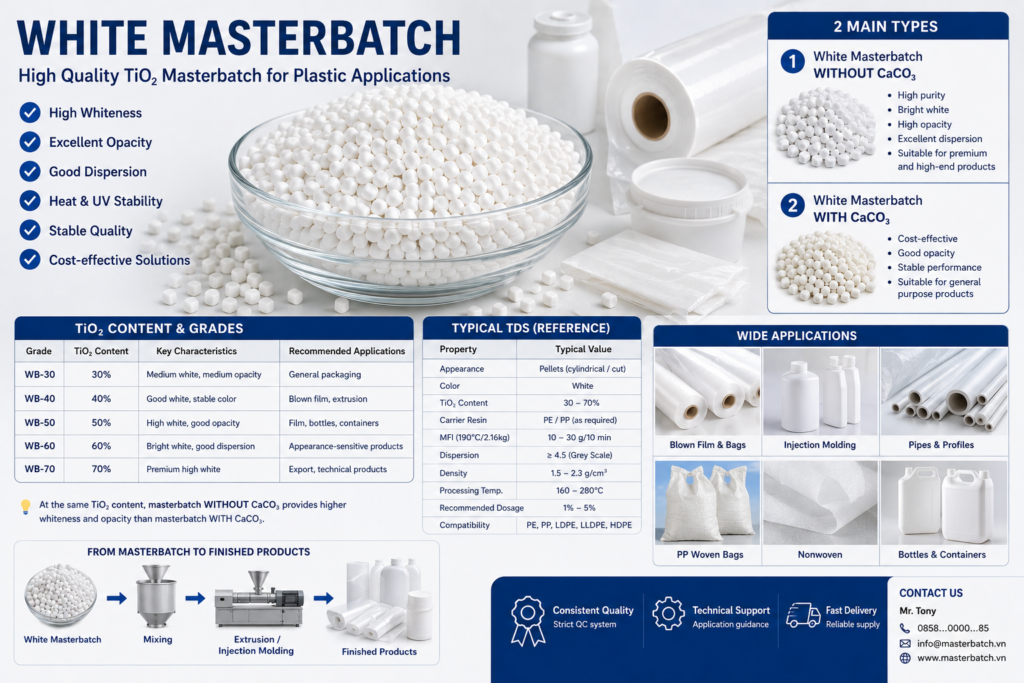
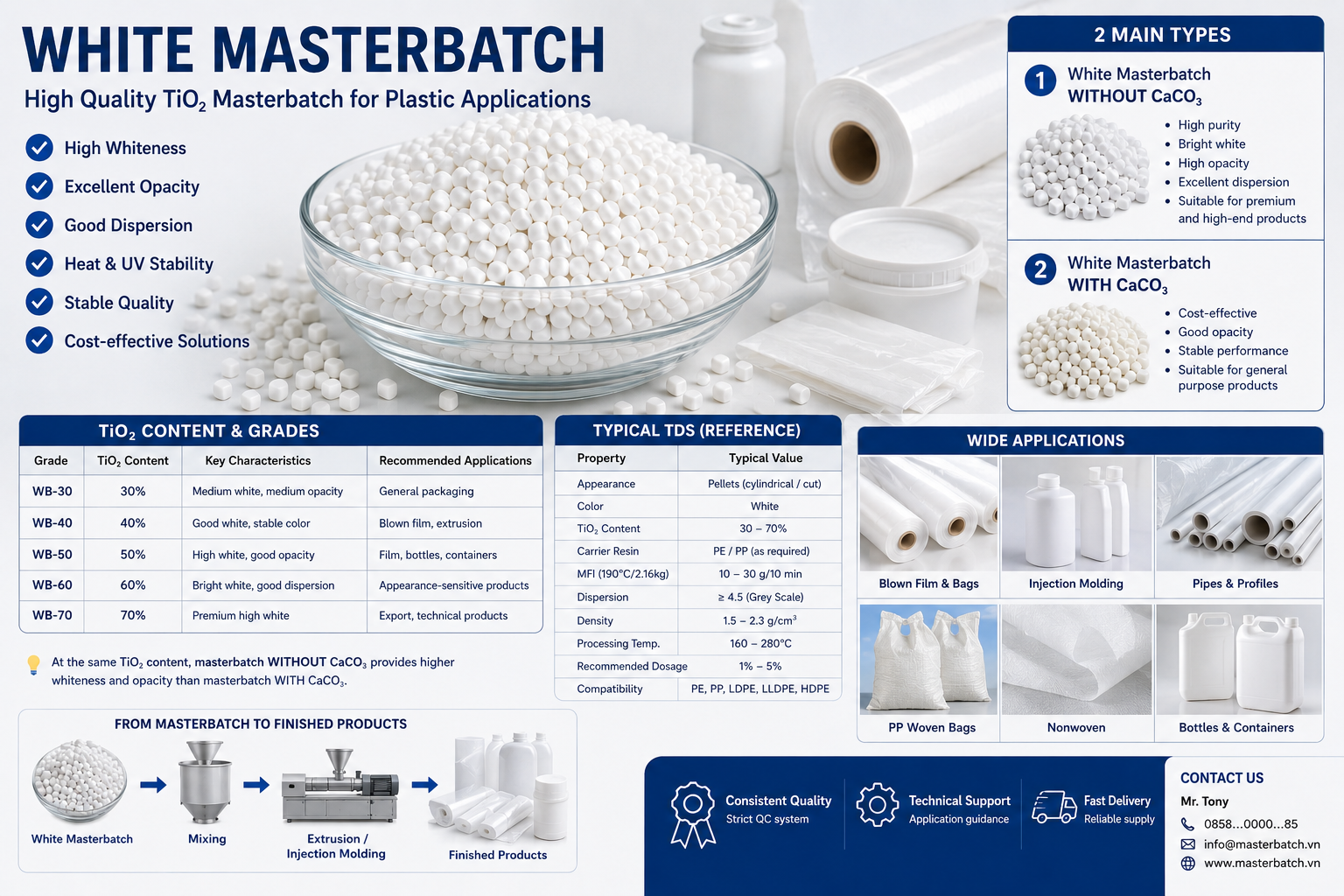
White Masterbatch is a concentrated plastic compound containing Titanium Dioxide (TiO₂) dispersed in a compatible carrier resin. It is widely used to produce white coloration, improve opacity, increase brightness and enhance the visual appearance of plastic products.
In industrial plastic manufacturing, white masterbatch affects more than just the final color. The formulation can also influence:
Opacity and covering power
Surface brightness and gloss
Pigment dispersion
Processing performance
Certain physical and mechanical properties
Production cost
At Masterbatch.vn, white masterbatch solutions can be developed for different polymers, processing technologies and application requirements, including PE, PP, LDPE, LLDPE and HDPE systems.
1. Overview of White Masterbatch in the Plastics Industry
White Masterbatch is produced by dispersing a high concentration of TiO₂ pigment into a polymer carrier resin together with selected dispersing and processing additives.
During plastic processing, the masterbatch is mixed with the base resin and melted. The TiO₂ pigment is then distributed throughout the polymer matrix to create the required level of whiteness and opacity.
The final performance depends on several factors, including:
TiO₂ type and concentration
Pigment dispersion
Carrier resin compatibility
Masterbatch dosage
Product thickness
Processing temperature
Processing technology
Base polymer
Therefore, selecting the right white masterbatch grade is important for achieving consistent production quality.
2. White Masterbatch Classification by Composition
White masterbatch for plastics can generally be divided into two major groups according to the formulation.
2.1. White Masterbatch Without CaCO₃
High-Purity White Masterbatch – No Filler
This type of white masterbatch is formulated primarily with TiO₂, carrier resin and functional additives, without calcium carbonate filler.
Typical Composition
TiO₂: approximately 30%–70%
Carrier resin: PE, PP, PS, ABS or other polymers depending on the application
Dispersing and processing additives
Key Characteristics
White masterbatch without CaCO₃ is generally selected for applications requiring:
High whiteness
Bright white appearance
Strong opacity
Excellent pigment dispersion
Lower filler-related impact on certain mechanical properties
High-quality surface appearance
It is particularly suitable for products where appearance, color consistency and overall product performance are important.
Typical applications include premium packaging, thin films, injection-molded products and products intended for demanding domestic or export markets.
2.2. White Masterbatch with CaCO₃ Filler
Economical White Masterbatch with Calcium Carbonate
This formulation contains TiO₂ together with Calcium Carbonate (CaCO₃), polymer carrier resin and selected additives.
Typical Composition
TiO₂: approximately 30%–70%
CaCO₃: according to the formulation
Carrier resin: PE, PP or other suitable polymers
Functional additives
Key Characteristics
White masterbatch containing CaCO₃ can provide:
Good white coloration
Good opacity
Cost optimization
Suitable processing performance
Potential filler-related cost advantages
It can be suitable for general-purpose plastic products where the balance between color performance and production cost is an important consideration.
Typical applications include standard packaging, plastic bags, general industrial products and other cost-sensitive applications.
3. Common TiO₂ Concentrations for White Masterbatch
The appropriate TiO₂ concentration depends on the required whiteness, opacity, product thickness, dosage and processing conditions.
The following grades are examples of commonly used concentration levels:
Grade
TiO₂ Content
Typical Characteristics
Typical Applications
WB-30
30%
Moderate whiteness and opacity
General packaging
WB-40
40%
Good whiteness and stable coloration
Blown bags, extrusion
WB-50
50%
High whiteness and opacity
Films, bottles, containers
WB-60
60%
Bright white color and good dispersion
Appearance-sensitive products
WB-70
70%
Premium high-concentration formulation
Export and technical applications
These grade names are indicative and may be customized according to customer requirements.
Important Technical Note
At the same TiO₂ concentration, a formulation without CaCO₃ may provide higher whiteness and opacity than a formulation containing CaCO₃, depending on the TiO₂ grade, dispersion quality, carrier system, dosage and final product thickness.
Therefore, TiO₂ concentration alone should not be used as the only parameter when comparing white masterbatch performance.
4. Typical Technical Data Sheet (TDS)
The following table provides indicative technical specifications for white masterbatch. Actual values may vary according to the formulation, polymer carrier, TiO₂ grade and application.
Parameter
Typical Value
Appearance
Cylindrical or cut pellets
Color
White
TiO₂ Content
30–70%
Carrier Resin
PE / PP according to requirements
MFI (190°C / 2.16 kg)
10–30 g/10 min
Dispersion
≥ 4.5, according to the applicable test method
Density
Approximately 1.5–2.3 g/cm³
Processing Temperature
Approximately 160–280°C
Recommended Dosage
Approximately 1–5%
Compatibility
PE, PP, LDPE, LLDPE, HDPE
Note: The above values are typical reference ranges rather than guaranteed specifications. The actual TDS should be confirmed for each specific white masterbatch grade before commercial production.
5. Practical Applications of White Masterbatch
White masterbatch is widely used across different plastic-processing technologies.
5.1. PE / LLDPE Film Blowing
White masterbatch can be used in:
Shopping bags
Garbage bags
Packaging films
Agricultural films
Industrial films
Flexible packaging
For thin-film applications requiring high whiteness and good pigment dispersion, a high-quality formulation without CaCO₃ may be preferred.
5.2. Injection Molding
White masterbatch is widely used for:
Bottle caps
Plastic containers
Household products
Plastic components
Consumer products
Technical parts
The masterbatch carrier should be compatible with the injection-molding resin.
5.3. Extrusion
Applications include:
Plastic pipes
Plastic sheets
Profiles
Extruded components
Construction-related plastic products
Thermal stability and dispersion are important factors when selecting a masterbatch for extrusion.
5.4. PP Woven and Nonwoven Products
White masterbatch is also used in:
PP woven bags
Woven packaging
Nonwoven fabrics
Industrial sacks
Agricultural products
For these applications, the masterbatch should be selected according to the PP grade, extrusion conditions and required whiteness.
5.5. Bottles, Containers and Rigid Packaging
White masterbatch can be used in:
Plastic bottles
Jars
Containers
Canisters
Rigid packaging
Household packaging
The formulation should be selected according to the polymer, processing method and required product appearance.
6. Technical Recommendations by Application
Selecting white masterbatch according to the product structure and production requirements can improve overall performance.
Thin Products – High Whiteness Required
For thin films and products where a bright white appearance is important:
Recommended: high-dispersion, high-purity white masterbatch without CaCO₃.
Potential benefits include:
Higher visual whiteness
Better pigment dispersion
Stronger opacity
Attractive surface appearance
Thick Products – Cost Optimization Required
For thicker products where production cost is a major consideration:
Recommended: white masterbatch containing CaCO₃, provided the formulation is compatible with the required product performance.
Potential benefits include:
Cost optimization
Good white coloration
Suitable opacity
Efficient production
The optimum formulation should always be confirmed through actual production trials.
7. White Masterbatch With vs. Without CaCO₃
The following comparison provides a general technical reference:
Performance Factor
Without CaCO₃
With CaCO₃
Whiteness
High
Moderate to high
Opacity
Very good
Good
Pigment Purity
High
Depends on formulation
Impact on Mechanical Properties
Generally lower filler effect
Depends on CaCO₃ content and product
Cost
Higher
More economical
Typical Applications
Premium and appearance-sensitive products
General-purpose and cost-sensitive products
Actual performance depends on the complete formulation rather than on CaCO₃ content alone.
8. How to Select the Right White Masterbatch
Choosing the correct white masterbatch requires consideration of several technical parameters.
Step 1: Identify the Base Polymer
Determine whether the application uses:
LDPE
LLDPE
HDPE
PP
PS
ABS
Other polymers
Step 2: Identify the Processing Technology
Determine whether the product is manufactured by:
Film blowing
Injection molding
Extrusion
Blow molding
Fiber spinning
Woven production
Nonwoven production
Step 3: Define the Required Whiteness
Determine the required:
Whiteness
Opacity
Brightness
Surface appearance
Color consistency
Step 4: Select the TiO₂ Concentration
A higher TiO₂ concentration does not automatically mean better performance in every application. The correct grade depends on the masterbatch dosage and final product requirements.
Step 5: Conduct a Production Trial
Testing the masterbatch on the actual production line is recommended before placing a large commercial order.
9. Free White Masterbatch Sample Testing
Selecting the right white masterbatch should be based on actual application testing rather than price or TiO₂ concentration alone.
Masterbatch.vn can support customers with:
Free white masterbatch samples for testing
Technical guidance on TiO₂ concentration
Recommended masterbatch dosage
Support during production trials
Carrier-resin compatibility recommendations
Cost and performance optimization
A production trial allows manufacturers to evaluate:
Whiteness
Opacity
Pigment dispersion
Surface appearance
Processing stability
Final product performance
Actual production cost
10. White Masterbatch Supplier in Vietnam
Masterbatch.vn provides white masterbatch solutions for plastic manufacturers requiring different levels of whiteness, opacity, dispersion and cost efficiency.
Our solutions can be developed for PE, PP and other compatible polymer systems and can be customized according to:
TiO₂ concentration
Carrier resin
CaCO₃ content
Masterbatch dosage
Processing technology
Final product requirements
For international buyers, we recommend requesting a sample, technical data sheet (TDS), product specification and application guidance before purchasing large volumes.
11. Conclusion
White Masterbatch is an important material for plastic manufacturers seeking consistent white coloration, opacity and attractive surface appearance.
The two major formulation approaches—white masterbatch without CaCO₃ and white masterbatch with CaCO₃ filler—serve different production and cost requirements.
High-purity formulations without CaCO₃ are generally preferred for applications requiring high whiteness, opacity and premium appearance, while formulations containing CaCO₃ can provide a more economical solution for suitable general-purpose applications.
The optimum white masterbatch should be selected based on the base polymer, TiO₂ concentration, carrier resin, product thickness, processing technology, required whiteness, dosage and overall production economics.
Masterbatch.vn supports plastic manufacturers with white masterbatch samples, technical consultation and customized solutions for different production applications.
Request a White Masterbatch Sample
Contact Masterbatch.vn to discuss your application, request a sample and identify the most suitable white masterbatch grade for your production line.
White Masterbatch for Plastics: TiO₂ Grades, TDS & Applications | Masterbatch.vn
White Masterbatch for Plastics –
TiO₂ Grades, TDS and Practical Applications
Explore white masterbatch with 30–70% TiO₂,
with and without CaCO₃ filler, including
technical grades, TDS, applications,
dosage and production recommendations.
White Masterbatch – Titanium Dioxide Masterbatch
for Plastic Applications
Overview of White Masterbatch in the Plastics Industry
White Masterbatch is a concentrated plastic compound
containing Titanium Dioxide (TiO₂) dispersed in a
compatible carrier resin.
White Masterbatch Classification by Composition
White Masterbatch Without CaCO₃
White Masterbatch With CaCO₃ Filler
Common TiO₂ Concentrations for White Masterbatch
Grade
TiO₂ Content
Characteristics
Applications
WB-30
30%
Moderate whiteness and opacity
General packaging
WB-40
40%
Good whiteness and stable coloration
Blown film and extrusion
WB-50
50%
High whiteness and opacity
Films, bottles and containers
WB-60
60%
Bright white and good dispersion
Appearance-sensitive products
WB-70
70%
Premium high-concentration formulation
Export and technical applications
Typical Technical Data Sheet (TDS)
Parameter
Typical Value
Appearance
Cylindrical or cut pellets
Color
White
TiO₂ Content
30–70%
Carrier Resin
PE / PP according to requirements
MFI (190°C / 2.16 kg)
10–30 g/10 min
Density
Approximately 1.5–2.3 g/cm³
Processing Temperature
Approximately 160–280°C
Recommended Dosage
Approximately 1–5%
Compatibility
PE, PP, LDPE, LLDPE, HDPE
Technical specifications may vary according to
the formulation, polymer carrier, TiO₂ grade,
processing technology and application.
Practical Applications of White Masterbatch
PE and LLDPE blown film
Plastic bags and packaging films
Injection-molded products
Plastic pipes, sheets and profiles
PP woven and nonwoven products
Bottles and rigid packaging
Agricultural plastic products
White Masterbatch With vs. Without CaCO₃
Performance Factor
Without CaCO₃
With CaCO₃
Whiteness
High
Moderate to high
Opacity
Very good
Good
Filler Effect
Lower
Depends on CaCO₃ content
Cost
Higher
More economical
Typical Applications
Premium and appearance-sensitive products
General-purpose products
White Masterbatch Supplier in Vietnam
Masterbatch.vn provides white masterbatch solutions
for plastic manufacturers requiring different levels
of whiteness, opacity, dispersion and cost efficiency.
Our solutions can be developed for PE, PP and other
compatible polymer systems according to TiO₂
concentration, carrier resin, CaCO₃ content,
dosage and processing technology.
Free White Masterbatch Sample Testing
Contact Masterbatch.vn to request a white masterbatch
sample and receive technical guidance for your
production application.
White masterbatch sample testing
TiO₂ concentration recommendations
Masterbatch dosage guidance
Production trial support
Cost and performance optimization
Conclusion
White Masterbatch is an important material for
plastic manufacturers seeking consistent white
coloration, opacity, surface appearance and
efficient production.
Masterbatch.vn supports manufacturers with white
masterbatch samples, technical consultation and
customized solutions for different plastic
processing applications.