
Transparent Filler Masterbatch – Na₂SO₄ & BaSO₄ Filler for Plastic
1. What Is Transparent Filler Masterbatch?
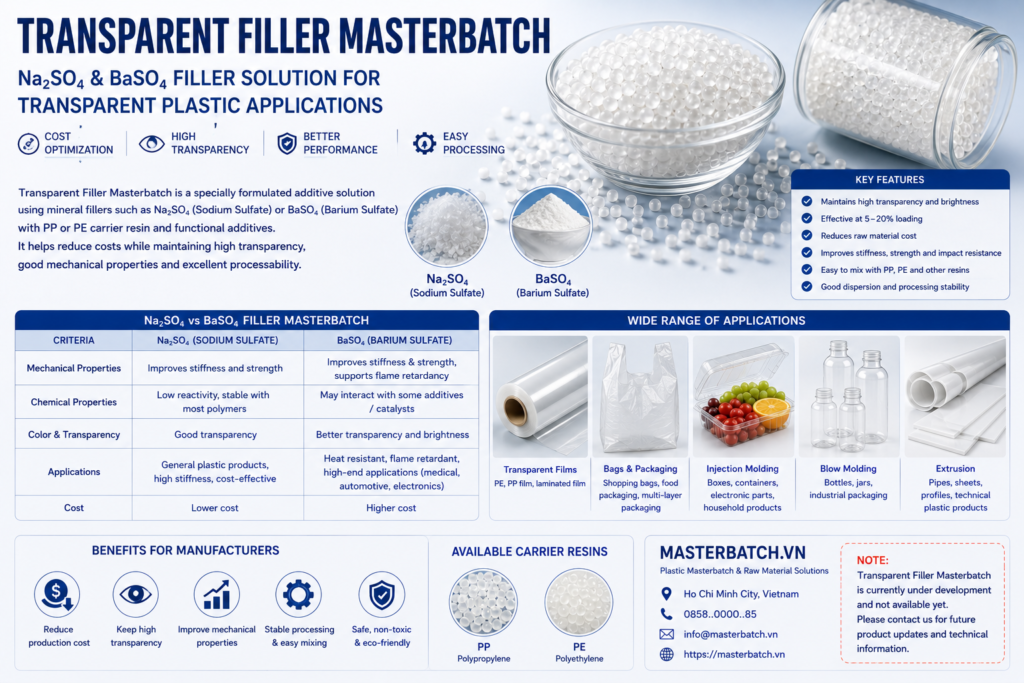
Transparent Filler Masterbatch is a specially formulated plastic additive designed to help manufacturers optimize raw-material costs while maintaining an attractive level of transparency, brightness and surface appearance in suitable plastic products.
Unlike conventional calcium carbonate filler masterbatch, transparent filler systems can use mineral fillers such as Sodium Sulfate (Na₂SO₄) or Barium Sulfate (BaSO₄) in combination with a compatible polymer carrier such as PP or PE and specialized additives.
A typical formulation may include:
-
Polymer carrier resin: PP, PE or another compatible resin
-
Transparent mineral filler: Na₂SO₄ or BaSO₄
-
Dispersing additives
-
Thermal stabilizers
-
Processing and moisture-control additives
The objective is to achieve an effective balance between filler loading, optical appearance, mechanical properties, processability and material cost.
For plastic manufacturers, this makes Transparent Filler Masterbatch an interesting option for applications where conventional mineral fillers may reduce transparency more significantly.
2. Why Use Transparent Filler Masterbatch?
In many plastic applications, manufacturers need to control production costs without significantly changing the visual appearance of the final product.
Traditional fillers can increase opacity or whiteness, which may not be suitable for products requiring a relatively transparent appearance.
A properly designed Transparent Filler Masterbatch can help address this challenge by using mineral fillers with different optical characteristics and suitable particle-size control.
Potential benefits include:
-
Raw-material cost optimization
-
Good filler dispersion
-
Controlled transparency and appearance
-
Improved stiffness in suitable formulations
-
Better dimensional stability
-
Efficient processing
-
Reduced virgin polymer consumption in appropriate applications
The actual level of transparency and mechanical performance depends on the filler type, particle size, concentration, carrier resin, dispersion quality and processing conditions.
3. Main Components of Transparent Filler Masterbatch
3.1. Polymer Carrier Resin
The carrier resin is selected according to the target application.
Common carrier systems include:
-
PP
-
PE
-
HDPE
-
LDPE
-
LLDPE
The carrier should have good compatibility with the customer’s base resin to ensure stable mixing and dispersion.
3.2. Sodium Sulfate (Na₂SO₄)
Sodium Sulfate (Na₂SO₄) can be used as a mineral filler in transparent filler masterbatch formulations designed for selected plastic applications.
Depending on the formulation, it can contribute to:
-
Increased stiffness
-
Controlled density
-
Material cost optimization
-
Stable processing
-
Suitable optical performance
The final transparency depends strongly on particle size, dispersion and polymer-filler interaction.
3.3. Barium Sulfate (BaSO₄)
Barium Sulfate (BaSO₄) is another mineral filler that can be incorporated into specialized plastic formulations.
It is known for its high density and chemical stability and can be used in applications requiring particular combinations of:
-
Density
-
Stiffness
-
Chemical resistance
-
Surface characteristics
-
Dimensional stability
Its suitability for transparent applications depends on particle characteristics and the complete formulation.
3.4. Processing Additives
Special additives may be incorporated to improve:
-
Filler dispersion
-
Thermal stability
-
Processing performance
-
Moisture control
-
Polymer-filler compatibility
-
Surface quality
4. Transparent Filler Masterbatch vs. Conventional Filler Masterbatch
One of the key differences between transparent filler masterbatch and conventional filler masterbatch is the optical performance of the filler system.
Traditional CaCO₃ Filler Masterbatch is widely used for cost optimization and stiffness but can increase opacity depending on loading and particle characteristics.
Transparent filler systems are developed for applications where manufacturers want to maintain a more transparent or translucent appearance.
Therefore, the choice should be based on the final product requirements rather than filler concentration alone.
Important factors include:
-
Transparency
-
Haze
-
Whiteness
-
Gloss
-
Stiffness
-
Tensile strength
-
Elongation
-
Density
-
Processing stability
-
Overall formulation cost
5. Na₂SO₄ vs. BaSO₄ Transparent Filler Masterbatch
The two mineral systems can offer different technical characteristics.
| Technical Factor | Na₂SO₄ Filler Masterbatch | BaSO₄ Filler Masterbatch |
|---|---|---|
| Main mineral | Sodium Sulfate | Barium Sulfate |
| Density | Lower than BaSO₄ | Relatively high |
| Stiffness | Can improve stiffness depending on formulation | Can improve stiffness and dimensional stability |
| Chemical stability | Suitable for many applications | High chemical stability |
| Optical performance | Formulation-dependent | Formulation-dependent |
| Cost | Generally more economical | Generally higher |
| Typical positioning | Cost-sensitive applications | Specialized / higher-performance applications |
| Processing | Application-dependent | Application-dependent |
Technical note: Neither Na₂SO₄ nor BaSO₄ should automatically be considered a universal transparent filler. Optical properties depend on particle size, refractive index, dispersion, concentration and the polymer matrix. Actual performance should be confirmed through laboratory and production testing.
6. Can Transparent Filler Masterbatch Maintain Transparency?
This is one of the most important questions for plastic manufacturers.
The answer depends on the complete formulation.
A transparent filler masterbatch is designed to minimize the negative effect of mineral filler on optical appearance. However, increasing filler loading can still affect:
-
Transparency
-
Haze
-
Gloss
-
Color
-
Surface appearance
For this reason, manufacturers should evaluate the optical properties of the final product, rather than judging performance solely from the masterbatch appearance.
Important test parameters may include:
-
Total transmittance
-
Haze
-
Gloss
-
Whiteness
-
Color difference (ΔE)
The optimum dosage should be established through actual production trials.
7. Recommended Dosage
Transparent Filler Masterbatch can potentially be used at different addition levels depending on the product and formulation.
For certain applications, manufacturers may evaluate dosage ranges such as 5%–20%, but the appropriate level must be determined according to:
-
Polymer type
-
Filler concentration
-
Product thickness
-
Required transparency
-
Mechanical requirements
-
Processing technology
-
Target production cost
Higher dosage does not necessarily mean better economics.
An excessively high filler concentration may negatively affect transparency, elongation, impact strength or other product properties.
Therefore, the best approach is to determine the lowest effective dosage that meets the required technical specifications.
8. Applications of Transparent Filler Masterbatch
Transparent Filler Masterbatch can be considered for a range of plastic-processing applications where cost optimization and controlled optical appearance are important.
Transparent and Translucent Films
Potential applications include:
-
PE films
-
PP films
-
Packaging films
-
Laminated films
-
Industrial films
For film applications, dispersion and optical properties are particularly important.
Plastic Bags and Packaging
Depending on the required appearance and mechanical specifications, transparent filler masterbatch may be evaluated for:
-
Shopping bags
-
Packaging bags
-
General-purpose plastic packaging
-
Selected multilayer packaging applications
Injection Molding
Specialized grades may be evaluated for:
-
Plastic containers
-
Household products
-
Industrial components
-
Consumer products
-
Selected technical parts
Extrusion
Applications may include selected:
-
Plastic sheets
-
Profiles
-
Extruded products
-
Film-related applications
The appropriate grade should be selected according to the polymer and extrusion process.
9. Transparent Filler Masterbatch for PE and PP
The carrier resin plays an important role in determining compatibility and processing performance.
PE Applications
For PE-based products, the masterbatch can be formulated for compatibility with:
-
LDPE
-
LLDPE
-
HDPE
Potential applications include film, bags, packaging and selected extrusion products.
PP Applications
For PP-based products, suitable formulations can be considered for:
-
PP films
-
Injection molding
-
Woven products
-
Extrusion
-
Household plastic products
A PP-compatible carrier is recommended when the base resin is polypropylene.
10. Technical Factors That Affect Transparency
The optical performance of a transparent filler masterbatch depends on several technical parameters.
Particle Size
Smaller and more controlled particles can contribute to better dispersion and optical performance in suitable systems.
Particle Dispersion
Poor dispersion can cause:
-
Visible particles
-
Haze
-
Surface defects
-
Uneven appearance
-
Reduced mechanical consistency
Filler Loading
Increasing mineral filler concentration can affect transparency and haze.
Therefore, the optimal loading must be established experimentally.
Polymer Compatibility
The interaction between the filler and polymer matrix can significantly influence the optical properties of the finished product.
Processing Conditions
Temperature, screw configuration, mixing intensity and cooling conditions can all influence filler dispersion and final product appearance.
11. Quality Control for Transparent Filler Masterbatch
For industrial applications, quality consistency is critical.
A professional quality-control program may evaluate:
-
Filler concentration
-
Moisture
-
Particle-size distribution
-
Filler dispersion
-
MFI / MFR
-
Density
-
Thermal stability
-
Optical properties
-
Pellet consistency
-
Batch-to-batch variation
For customers producing transparent or translucent products, additional testing of the finished product is recommended.
This may include:
-
Haze measurement
-
Light transmission
-
Gloss measurement
-
Color measurement
-
Mechanical testing
12. Advantages for Plastic Manufacturers
When correctly formulated and applied, Transparent Filler Masterbatch can provide several commercial and technical advantages.
Cost Optimization
The masterbatch can reduce the amount of virgin polymer required in suitable formulations.
Improved Stiffness
Mineral fillers can contribute to increased rigidity in selected polymer systems.
Controlled Density
Depending on the filler and loading level, the formulation can be designed to achieve a target density.
Processing Efficiency
A well-dispersed masterbatch can provide stable feeding and mixing during production.
Product Customization
The formulation can be adjusted according to:
-
Polymer type
-
Product thickness
-
Transparency target
-
Mechanical requirements
-
Processing technology
-
Cost target
13. How to Select the Right Transparent Filler Masterbatch
Choosing the correct product requires more than comparing filler percentages.
Manufacturers should evaluate:
-
Polymer compatibility
-
Filler type
-
Particle size
-
Filler concentration
-
Dispersion quality
-
MFI / MFR compatibility
-
Transparency and haze
-
Mechanical performance
-
Recommended dosage
-
Processing temperature
A technical sample test is strongly recommended before commercial-scale production.
14. Transparent Filler Masterbatch Development at Masterbatch.vn
Masterbatch.vn provides information and technical solutions related to plastic masterbatch and filler masterbatch technologies.
Transparent filler masterbatch is currently an area under development and evaluation, and Masterbatch.vn does not currently offer a commercial Transparent Filler Masterbatch product.
Future product development may focus on formulations based on:
-
Na₂SO₄
-
BaSO₄
-
PP carrier systems
-
PE carrier systems
-
Specialized dispersing additives
The objective is to develop formulations that provide an appropriate balance between optical performance, mechanical properties, processing stability and cost efficiency.
15. Why Transparent Filler Masterbatch Is Important for the Future of Plastics
The plastic industry is continuously looking for ways to improve material efficiency and production economics.
Transparent filler technology represents one potential approach for applications where manufacturers need to reduce polymer consumption while maintaining an acceptable visual appearance.
The future development of this technology will depend on improvements in:
-
Mineral particle engineering
-
Dispersion technology
-
Polymer-filler compatibility
-
Optical control
-
Processing technology
-
Application-specific formulation
As a result, transparent filler masterbatch can become a valuable area of innovation for manufacturers seeking more efficient plastic formulations.
16. Frequently Asked Questions
What is Transparent Filler Masterbatch?
Transparent Filler Masterbatch is a concentrated filler system designed to introduce selected mineral fillers into plastic while maintaining controlled optical properties in suitable applications.
What minerals are used?
Common systems discussed for transparent filler applications include Na₂SO₄ (Sodium Sulfate) and BaSO₄ (Barium Sulfate).
Can it be used with PE and PP?
Yes. Suitable formulations can be developed for PE and PP systems, provided that the carrier resin and additives are compatible with the base polymer.
Does transparent filler masterbatch reduce product transparency?
It can affect transparency and haze depending on loading and formulation. The purpose of a transparent filler system is to minimize this effect, but actual performance must be verified through testing.
Is Transparent Filler Masterbatch available from Masterbatch.vn?
Not currently. Masterbatch.vn is currently developing and evaluating this technology and does not currently have a commercial product available.
17. Conclusion
Transparent Filler Masterbatch is a specialized filler technology designed to help plastic manufacturers explore the balance between material cost, transparency, stiffness and processing performance.
Compared with conventional filler systems, formulations based on Na₂SO₄ or BaSO₄ may offer different optical and physical characteristics when properly engineered.
The most important factors are not simply filler concentration, but the complete combination of:
Filler Type + Particle Size + Dispersion + Polymer Carrier + Dosage + Processing Conditions
For manufacturers interested in transparent filler technology, laboratory evaluation and production trials are essential before selecting a commercial formulation.
Contact Masterbatch.vn
Masterbatch.vn
Ho Chi Minh City, Vietnam
Email: info@masterbatch.vn
Website: masterbatch.vn
For future product-development inquiries regarding Transparent Filler Masterbatch, contact Masterbatch.vn for technical information and development updates.