This technical guide is prepared by MASTERBATCH.VN – Your Trusted Partner in Plastic Masterbatch & Raw Material Solutions.
PP (Polypropylene) woven bags are widely used for packaging rice, coffee, pepper, animal feed, fertilizers, cement, chemicals, and many other industrial products. Their outstanding strength, moisture resistance, and excellent printability make them one of the most popular packaging solutions worldwide.
However, producing high-quality PP woven bags requires much more than premium machinery. Success depends on selecting the right plastic raw materials, maintaining accurate formulation ratios, controlling extrusion temperatures, and ensuring consistent quality throughout every production stage.
This guide explains the recommended material formulations, processing temperatures, production parameters, and quality control practices for modern PP woven bag manufacturing.
1. Plastic Raw Materials for PP Woven Bags
The performance of a woven PP bag begins with the quality of its raw materials.
Virgin PP Resin
Virgin polypropylene serves as the primary polymer, providing:
- Excellent tensile strength
- High impact resistance
- Superior appearance
- Stable processing performance
- Long product lifespan
Recycled PP Resin
Recycled polypropylene can reduce production costs while supporting sustainable manufacturing.
Typical usage ranges from 10–20%, depending on product specifications and mechanical property requirements.
Color Masterbatch
Color masterbatch provides:
- Uniform coloration
- UV-stable pigments
- Excellent color consistency
- Enhanced product appearance
Plastic Additives
Functional additives improve overall performance, including:
- UV Stabilizers
- Slip Additives
- Anti-static Additives
- Processing Aids
- Ink Adhesion Enhancers
- Anti-block Additives
MASTERBATCH.VN supplies complete material solutions specifically designed for PP woven bag production.
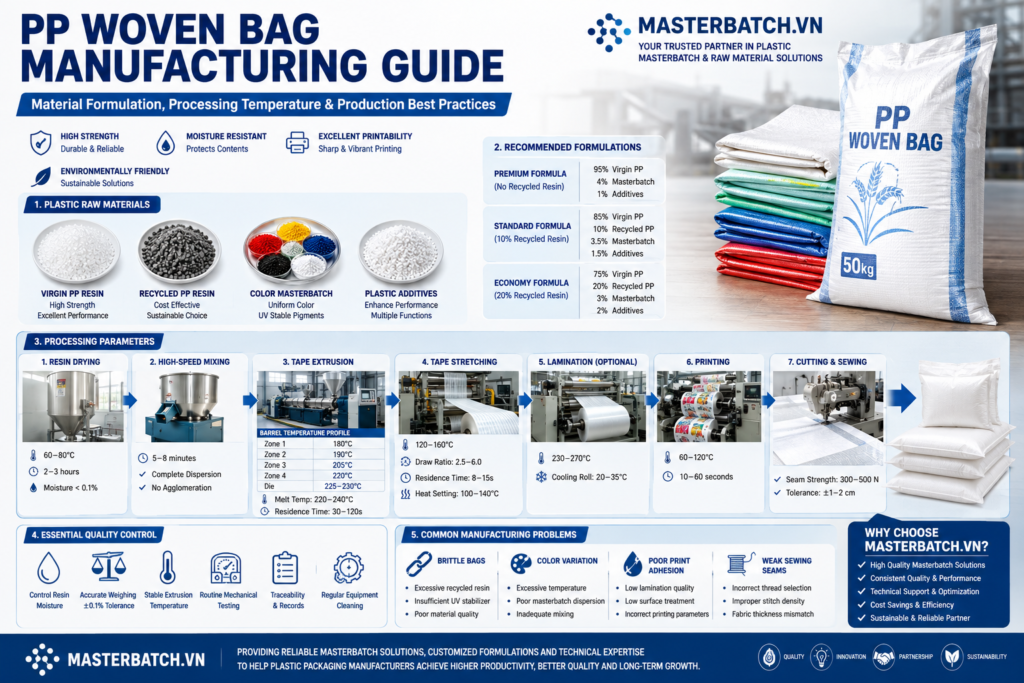
2. Recommended Material Formulations
The following formulations are commonly used in industrial production.
Premium Formula (No Recycled Resin)
Composition:
- 95% Virgin PP Resin
- 4% Masterbatch
- 1% Plastic Additives
Batch Example
100 kg Mixer
- 95 kg Virgin PP
- 4 kg Masterbatch
- 1 kg Additives
200 kg Mixer
- 190 kg Virgin PP
- 8 kg Masterbatch
- 2 kg Additives
Standard Formula (10% Recycled Resin)
- 85% Virgin PP
- 10% Recycled PP
- 3.5% Masterbatch
- 1.5% Additives
Economy Formula (20% Recycled Resin)
- 75% Virgin PP
- 20% Recycled PP
- 3% Masterbatch
- 2% Additives
Manufacturers should select formulations according to product specifications, customer requirements, and mechanical performance targets while balancing production costs.
3. Processing Parameters
3.1 Resin Drying
Recommended conditions:
- Temperature: 60–80°C
- Drying Time: 2–3 hours
- Final Moisture: Below 0.1%
For recycled resin:
- Up to 80°C
- Approximately 4 hours
Proper drying minimizes moisture defects and improves extrusion stability.
3.2 High-Speed Mixing
Recommended settings:
- Mixing Time: 5–8 minutes
- Ambient Temperature
- Ensure complete dispersion of masterbatch and additives
- Avoid material agglomeration
3.3 Tape Extrusion
Recommended barrel temperature profile:
| Extruder Zone | Temperature |
|---|---|
| Zone 1 | 180°C |
| Zone 2 | 190°C |
| Zone 3 | 205°C |
| Zone 4 | 220°C |
| Die | 225–230°C |
Additional parameters:
- Melt Temperature: 220–240°C
- Residence Time: 30–120 seconds
Stable melt temperature is essential for producing uniform tapes with excellent mechanical strength.
3.4 Tape Stretching (Drawing)
Typical conditions:
- Oven Temperature: 120–160°C
- Draw Ratio: 2.5–6.0
- Residence Time: 8–15 seconds
- Heat Setting: 100–140°C
Proper drawing significantly improves tensile strength and dimensional stability.
3.5 Lamination (Optional)
For laminated woven bags:
- Extrusion Temperature: 230–270°C
- Cooling Roll Temperature: 20–35°C
Lamination enhances moisture resistance and printing performance.
3.6 Printing
Recommended ink drying conditions:
- Drying Temperature: 60–120°C
- Drying Time: 10–60 seconds
Actual settings depend on ink type, machine speed, and printing technology.
3.7 Cutting & Sewing
Quality requirements include:
- Strong sewing seams
- Seam Strength: 300–500 N
- Dimensional Tolerance: ±1–2 cm
Final inspection ensures product consistency before packaging.
4. Essential Quality Control Practices
Consistent quality depends on strict production management.
Key recommendations include:
- Control resin moisture before extrusion.
- Maintain accurate material weighing with a tolerance within ±0.1%.
- Keep extrusion temperatures stable to prevent burnt resin and brittle tapes.
- Perform routine mechanical testing for tensile strength, elongation, and seam performance.
- Record batch numbers, material lots, and machine settings for complete production traceability.
- Clean extrusion equipment regularly to eliminate carbon contamination, black specks, and color inconsistency.
5. Common Manufacturing Problems
Brittle Bags
Possible causes:
- Excessive recycled resin
- Insufficient UV stabilizer
- Poor material quality
Color Variation
Possible causes:
- Excessive processing temperature
- Inadequate masterbatch dispersion
- Poor mixing performance
Poor Print Adhesion
Possible causes:
- Insufficient lamination quality
- Low surface treatment
- Incorrect printing parameters