
PP Filler Masterbatch – CaCO₃ Masterbatch for PP Plastic Applications
PP Filler Masterbatch – CaCO₃ Masterbatch for PP Plastic Applications
1. What Is PP Filler Masterbatch?
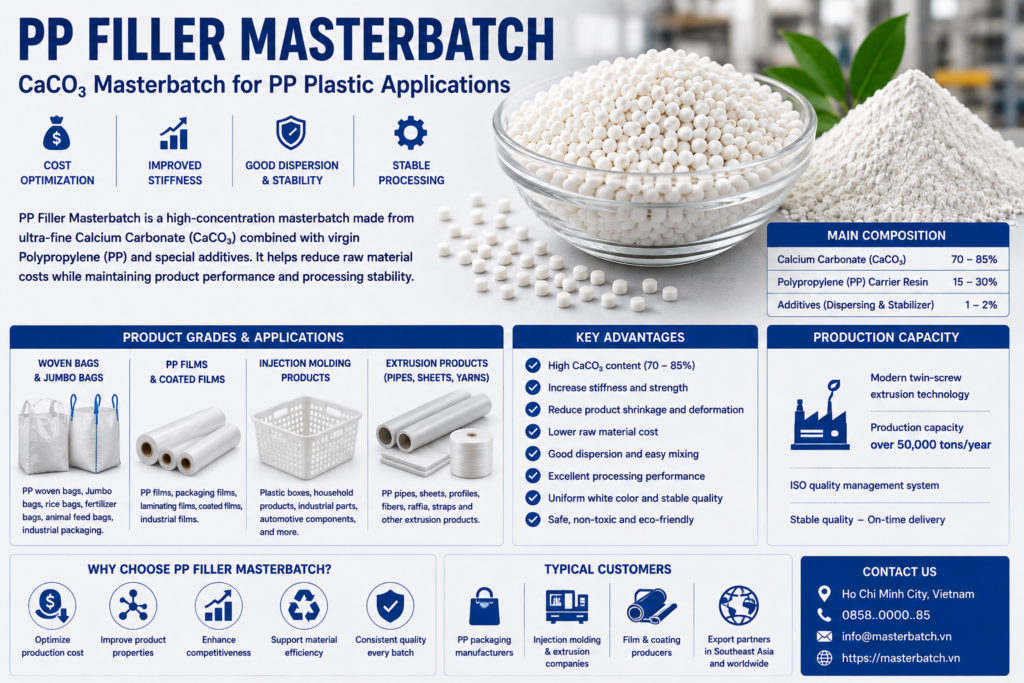
PP Filler Masterbatch is a high-concentration plastic additive masterbatch made from finely processed Calcium Carbonate (CaCO₃) combined with a Polypropylene (PP) carrier resin and specially selected processing additives.
It is widely used in the plastic manufacturing industry as a practical solution for optimizing raw-material costs while maintaining the required physical and processing performance of finished plastic products.
A properly formulated PP Filler Masterbatch can help manufacturers improve selected properties such as:
-
Product stiffness
-
Dimensional stability
-
Processing efficiency
-
Surface appearance
-
Production economics
-
Material utilization
For manufacturers producing PP woven bags, Jumbo bags, injection-molded products, films, sheets and other PP-based products, selecting the correct filler masterbatch grade is important for achieving consistent production quality.
2. Main Composition of PP Filler Masterbatch
A typical PP Filler Masterbatch consists of three main components:
High-Purity Calcium Carbonate (CaCO₃)
Ultra-fine Calcium Carbonate powder is used as the primary mineral filler.
Depending on the formulation and target application, CaCO₃ loading can typically range from approximately 70% to 85%.
The quality of the CaCO₃ filler, including particle size, purity and dispersion characteristics, has a direct impact on the performance of the final masterbatch.
Polypropylene (PP) Carrier Resin
A compatible virgin PP carrier resin is used to encapsulate and distribute the CaCO₃ particles throughout the masterbatch.
The carrier system is selected according to the intended application, processing technology and compatibility requirements.
Processing Additives
Specialized additives may be incorporated to improve:
-
Filler dispersion
-
Thermal stability
-
Processing behavior
-
Polymer-filler compatibility
-
Surface quality
The combination of CaCO₃ + PP carrier resin + processing additives creates a concentrated filler masterbatch that can be easily blended with PP resin during plastic processing.
3. PP Filler Masterbatch Grades and Applications
Different plastic products require different formulations. Therefore, PP Filler Masterbatch can be customized according to the manufacturing process and final-product requirements.
PP Filler Masterbatch for Woven Bags
PP Filler Masterbatch is widely used in the production of:
-
PP woven bags
-
Rice bags
-
Fertilizer bags
-
Animal-feed bags
-
Industrial packaging bags
-
Jumbo bags / FIBC
For woven applications, the masterbatch should provide good dispersion and stable processing while maintaining an appropriate balance between stiffness, tensile performance and cost.
PP Filler Masterbatch for Jumbo Bags
For large woven packaging products such as Jumbo bags and FIBC, the formulation must be carefully selected because mechanical performance and dimensional stability are important.
A suitable grade can help manufacturers optimize material consumption while maintaining the required product specifications.
PP Filler Masterbatch for Film Applications
Certain PP film applications can also use CaCO₃-based filler masterbatch.
Potential applications include:
-
PP films
-
Packaging films
-
Laminating films
-
Coating applications
-
Industrial films
The recommended filler loading and dosage should be determined through production testing because excessive filler content can affect flexibility, elongation and film strength.
PP Filler Masterbatch for Injection Molding
PP Filler Masterbatch can be used in selected injection-molding applications, including:
-
Plastic containers
-
Household products
-
Industrial components
-
Plastic boxes
-
Automotive-related plastic parts
-
General injection-molded products
CaCO₃ filler can help increase stiffness and dimensional stability in suitable PP formulations.
PP Filler Masterbatch for Extrusion
Suitable grades can also be developed for PP extrusion applications such as:
-
Plastic sheets
-
Profiles
-
Extruded components
-
Selected plastic pipes
-
Technical plastic products
The formulation should be matched to the extrusion temperature, screw configuration and required mechanical properties.
4. Key Advantages of PP Filler Masterbatch
High-quality PP Filler Masterbatch offers several potential advantages for plastic manufacturers.
4.1. High CaCO₃ Loading
A high concentration of calcium carbonate allows manufacturers to introduce mineral filler efficiently into the PP formulation.
This can help optimize the overall formulation and reduce the consumption of virgin polymer in suitable applications.
4.2. Good Filler Dispersion
Uniform dispersion is one of the most important characteristics of a quality filler masterbatch.
Good dispersion helps reduce agglomeration and provides more consistent performance throughout the production process.
4.3. Improved Stiffness
Calcium carbonate can increase the stiffness of selected PP products.
This is particularly useful for products where rigidity and dimensional stability are important.
4.4. Cost Optimization
One of the major reasons manufacturers use PP Filler Masterbatch is to optimize material costs.
Replacing a portion of virgin PP with a properly formulated CaCO₃ filler system can reduce the polymer cost of suitable products.
However, the optimum formulation should always consider the balance between cost, mechanical performance and processing stability.
4.5. Reduced Shrinkage
In suitable injection-molding and molded-product applications, mineral fillers can help control dimensional changes and reduce shrinkage.
Actual results depend on:
-
Filler loading
-
PP grade
-
Product geometry
-
Mold design
-
Processing conditions
4.6. Stable Processing
A well-designed PP Filler Masterbatch should provide consistent feeding and dispersion during processing.
This is particularly important for high-volume production where batch-to-batch consistency directly affects manufacturing efficiency.
5. Technical Considerations When Using PP Filler Masterbatch
The performance of a filler masterbatch depends not only on CaCO₃ content but also on the complete formulation and processing conditions.
Important technical factors include:
-
CaCO₃ purity
-
Particle size
-
Particle-size distribution
-
Filler dispersion
-
PP carrier resin
-
Melt Flow Index (MFI)
-
Additive system
-
Recommended dosage
-
Processing temperature
-
Screw configuration
Therefore, manufacturers should avoid selecting a product based solely on CaCO₃ percentage.
A lower-cost masterbatch with poor dispersion may ultimately increase production problems, while a properly engineered grade can provide better overall production economics.
6. Recommended Dosage
The appropriate dosage of PP Filler Masterbatch depends on the product and processing technology.
Typical dosage should be established through actual production trials.
Factors affecting dosage include:
-
Final product specifications
-
Required stiffness
-
Tensile strength
-
Elongation
-
Impact resistance
-
Surface appearance
-
Processing equipment
-
Virgin PP grade
-
Target production cost
For demanding applications, it is recommended to begin with a controlled trial and gradually optimize the filler level until the desired balance between cost and performance is achieved.
Technical note: Recommended dosage should always be confirmed through testing with the actual PP resin, machine and final product.
7. PP Filler Masterbatch for PP Woven Bags
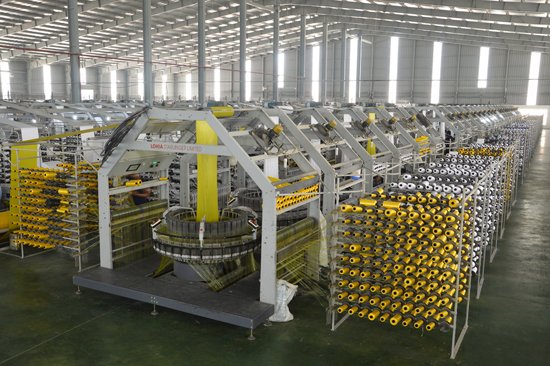
The PP woven bag industry is one of the important applications for PP-based filler masterbatch.
Manufacturers of woven bags often need to balance:
Material Cost + Stiffness + Tensile Performance + Processability + Production Speed
A suitable PP Filler Masterbatch can help optimize the formulation while maintaining the required performance of the finished woven product.
Typical applications include:
-
Rice bags
-
Fertilizer bags
-
Feed bags
-
Chemical packaging
-
Construction-material bags
-
Industrial woven bags
-
Jumbo bags
The correct grade should be selected according to the tape extrusion process, weaving conditions and final bag specifications.
8. PP Filler Masterbatch for Injection Molding
Injection molding requires consistent material flow, dimensional stability and surface quality.
For this reason, a suitable PP Filler Masterbatch for injection molding should be formulated with attention to:
-
MFI compatibility
-
Filler dispersion
-
Mold temperature
-
Processing temperature
-
Injection pressure
-
Cooling conditions
-
Product geometry
Applications may include household products, containers, industrial components and selected technical plastic parts.
9. Production Capacity and Quality Control
Masterbatch.vn provides plastic masterbatch and plastic raw-material solutions for manufacturers in Vietnam and international markets.
Industrial-scale Filler Masterbatch production typically uses modern twin-screw extrusion technology, which allows efficient mixing and dispersion of CaCO₃ within the polymer carrier.
The production process should include strict quality control for:
-
Raw-material quality
-
CaCO₃ content
-
Moisture
-
Filler dispersion
-
Pellet consistency
-
MFI
-
Thermal stability
-
Carrier compatibility
-
Batch consistency
According to the supplied production information, the manufacturing system has a production capacity of more than 50,000 tons per year, supporting both domestic and export-oriented customers.
10. Quality Control of PP Filler Masterbatch
For industrial applications, consistent quality from batch to batch is essential.
Important quality parameters may include:
| Parameter | Typical Consideration |
|---|---|
| Appearance | Uniform white pellets |
| Main filler | Calcium Carbonate (CaCO₃) |
| CaCO₃ loading | Approximately 70–85%, depending on grade |
| Carrier resin | Polypropylene (PP) |
| Dispersion | Uniform and stable |
| MFI | Grade-dependent |
| Thermal stability | Suitable for PP processing |
| Pellet consistency | Uniform |
| Recommended dosage | Application-dependent |
Actual technical specifications should be confirmed through the manufacturer’s Technical Data Sheet (TDS) for each individual grade.
11. How to Choose the Right PP Filler Masterbatch
When selecting a PP Filler Masterbatch supplier, plastic manufacturers should evaluate more than price.
Key criteria include:
1. CaCO₃ Quality
High-quality calcium carbonate with controlled particle size and purity contributes to better dispersion and consistent performance.
2. Carrier Resin Compatibility
The PP carrier should be compatible with the customer’s PP resin and processing technology.
3. Dispersion Performance
Good dispersion is critical for maintaining product consistency and minimizing processing defects.
4. MFI Compatibility
The masterbatch should have suitable flow characteristics for the intended production process.
5. Technical Support
A reliable supplier should be able to provide:
-
TDS
-
Product specifications
-
Recommended dosage
-
Sample testing
-
Technical guidance
-
Production-trial support
6. Supply Stability
For high-volume manufacturers, stable production capacity and consistent batch quality are essential for uninterrupted manufacturing.
12. PP Filler Masterbatch Manufacturer and Supplier in Vietnam
Vietnam has become an increasingly important manufacturing center for plastic products in Southeast Asia.
For plastic manufacturers sourcing PP Filler Masterbatch in Vietnam, important considerations include product quality, production capacity, technical support, logistics and export capability.
Masterbatch.vn focuses on providing information and solutions related to:
-
PP Filler Masterbatch
-
PE Filler Masterbatch
-
CaCO₃ Masterbatch
-
Calcium Carbonate Masterbatch
-
White Masterbatch
-
Black Masterbatch
-
Color Masterbatch
-
Functional Masterbatch
Our objective is to help plastic manufacturers select suitable materials based on technical requirements rather than price alone.
13. Environmental and Material Efficiency Considerations
Calcium carbonate is a naturally occurring mineral widely used in plastics.
When correctly formulated and applied, Filler Masterbatch can help manufacturers optimize polymer consumption and improve material efficiency in suitable applications.
However, environmental performance should always be evaluated across the entire product lifecycle, including:
-
Product design
-
Material selection
-
Manufacturing
-
Product lifetime
-
Recycling
-
End-of-life management
Therefore, Filler Masterbatch should be considered as one component of a broader material-efficiency strategy.
14. Why Choose PP Filler Masterbatch from Masterbatch.vn?
Masterbatch.vn provides technical solutions for plastic manufacturers looking to improve production efficiency and optimize raw-material costs.
Our Filler Masterbatch solutions are designed around several important requirements:
-
High CaCO₃ concentration
-
Good filler dispersion
-
PP carrier compatibility
-
Stable processing
-
Consistent pellet quality
-
Application-specific formulations
-
Cost optimization
-
Technical support
Whether you manufacture PP woven bags, Jumbo bags, films, injection-molded products or extruded plastic products, choosing the correct filler grade can have a significant impact on production performance.
15. Sample Testing and Technical Support
Before purchasing a large volume of PP Filler Masterbatch, manufacturers should conduct a production trial using their actual PP resin and processing equipment.
Masterbatch.vn can support customers with:
-
Product information
-
Filler masterbatch selection
-
Technical recommendations
-
Sample testing
-
Dosage optimization
-
Production-trial guidance
-
Cost-optimization solutions
Testing the material under actual production conditions is the most reliable method for determining the appropriate grade and dosage.
16. Conclusion
PP Filler Masterbatch is an important material solution for manufacturers seeking to optimize the cost and performance of PP-based plastic products.
Based on high-concentration Calcium Carbonate (CaCO₃), PP carrier resin and specialized additives, the product can be formulated for a wide range of applications, including:
-
PP woven bags
-
Jumbo bags
-
PP films
-
Injection molding
-
Extrusion
-
Plastic sheets
-
Selected technical plastic products
The most effective solution is not simply the masterbatch with the highest CaCO₃ loading. Instead, manufacturers should select a formulation that provides the right balance between:
CaCO₃ Loading + Dispersion + PP Compatibility + Processing Stability + Product Performance + Cost
For technical consultation, sample testing or product selection, contact Masterbatch.vn for suitable PP Filler Masterbatch and plastic raw-material solutions.
Contact Masterbatch.vn
Website: masterbatch.vn
Email: info@masterbatch.vn
Location: Ho Chi Minh City, Vietnam